
Why your biceps aren't growing, and what to do about it
Workouts by Tiff and Dan · Updated October 7, 2026
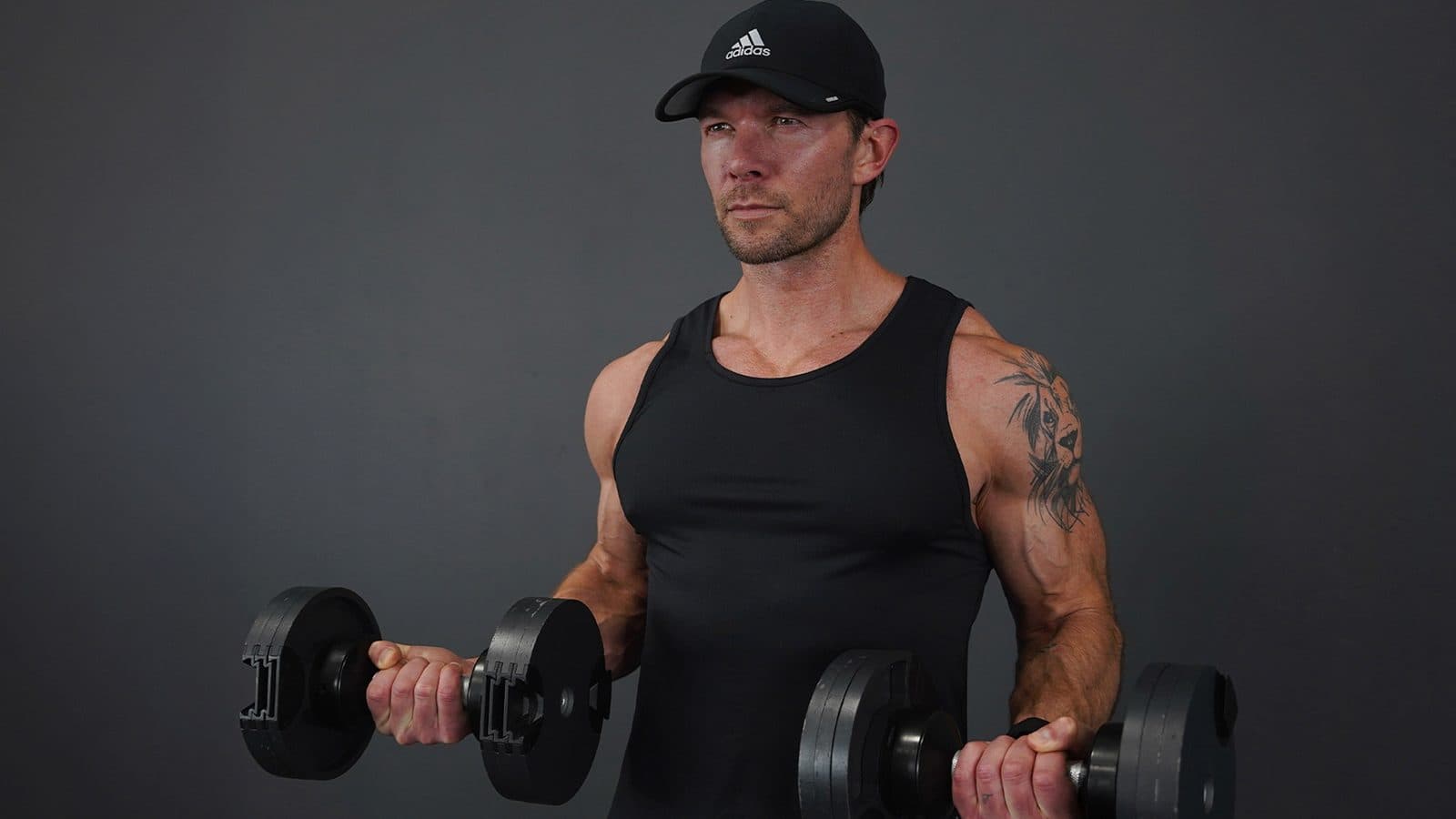
Biceps usually stall for one of eight reasons: too few hard sets, sets that stop too early, swinging the weight, no progression, only one kind of curl, not enough food, poor sleep, or not enough time. Most are quick to fix. Find yours in the table, then read that section.
- Want a workout now? Follow our 10 minute arm workout, bigger biceps or the 11 minute biceps workout.
- Biceps never get sore? That's not a problem on its own. Here's why.
- Felt a pop or sharp pain at the elbow? Read sore or hurt first.
| Reason | How to tell | What to change |
|---|---|---|
| Not enough hard sets | A few sets of curls, once a week | About 10 hard sets a week, over two sessions |
| Sets stop too early | You could do 5 or more reps at the end of a set | End each set with 0 to 3 good reps left |
| Momentum does the lifting | Your body swings or your elbows drift forward | Lighter weight, elbows at your sides, 3 seconds down |
| Same weight, same reps | Your workouts look the same as 3 months ago | Add a rep, then weight, then slow it down |
| Only one kind of curl | Every set is a standard curl | Add a hammer curl and a curl from a new arm position |
| Not eating enough | Your body weight hasn't moved in months | About 1.6 g of protein per kg a day, and a little more food |
| Poor sleep and recovery | Short nights, achy elbows, strength going down | More sleep, a day off between arm sessions |
| Expecting it to be quick | It's been a few weeks | Give it months, and track your strength |
How your biceps work
Your biceps sit on the front of your upper arm and have two parts, the long head and the short head. They do three jobs: bend your elbow, turn your palm up, and help lift your arm forward.
Two other muscles matter for how your arm looks. The brachialis sits under the biceps and bends the elbow whichever way your hand faces. The triceps, on the back of your arm, is the bigger muscle. So if you want bigger arms, train both.
1. Not enough hard sets, or too many
Muscle grows from hard sets, and more of them per week usually means more growth. A review of 15 studies found a clear link between weekly sets per muscle and muscle growth (Schoenfeld, Ogborn and Krieger, 2017).
- A good place to start: about 10 hard sets a week that work your biceps. Rows and chin ups count too, a little less than curls.
- Spread them out: two sessions a week, not one. A review found that training a muscle twice a week grew it more than once a week (Schoenfeld, Ogborn and Krieger, 2016).
- More isn't always better: if you curl every day and your elbows ache, cut back. Your biceps need time between sessions to recover.
2. Your sets stop too early
Ten easy reps don't do much. A set counts when the last few reps are hard. End each set with 0 to 3 good reps left: the weight slows down, but your form still holds.
If you could have done 5 more, go heavier or do more reps next time. You don't need to go to failure on every set.
3. Momentum is doing the lifting
When your body swings, your back and hips lift the weight and your biceps get a break. Signs: you lean back, your elbows drift forward, or the weight drops fast on the way down.
- Stand tall with your elbows at your sides.
- Lift without leaning back, and lower for about 3 seconds.
- Stop the set when you have to swing to finish a rep.
- Pick a weight you can control for 8 to 12 clean reps.
If you can't curl without swinging, go lighter. It will feel harder, not easier.
4. Same weight, same reps for months
Your biceps adapt to what you give them. If the workout never changes, neither will they. Make it a little harder, one step at a time:
- Add reps. Same weight, one or two more reps each week, until you reach the top of your range (say 12).
- Add weight. Then go up to the next dumbbells and drop back to 8 reps.
- Slow it down. At home, the jump to the next dumbbells is often too big. Lower for 3 to 4 seconds, pause with your elbow bent at 90 degrees, or add a set.
Write down your weights and reps. It's the easiest way to know you're progressing.
5. Only one kind of curl
Changing your arm and hand position changes where a curl is hardest and which muscles do more of the work. You don't need ten curls, just a mix:
- Arm at your side or behind you: incline curls on a bench, or drag curls. These start with your biceps on a stretch.
- Arm in front of you: concentration curls or preacher curls.
- Thumbs up or palms down: hammer curls and reverse curls put more of the work on the brachialis and your forearm.
Zottman curls do two at once: palms up on the way up, palms down on the way down.
6. Not eating enough to grow
You can't build much muscle without enough protein and enough food overall.
- Protein: about 1.6 g per kg of body weight a day, roughly 0.7 g per pound. For a 70 kg (154 lb) person, that's about 110 g. A review of 49 studies found that eating more than this didn't add more muscle (Morton et al., 2018). A later review found that extra protein gave small extra gains in lean mass with strength training, most clearly at 1.6 g per kg or more (Nunes et al., 2022).
- Food overall: if your body weight hasn't changed in months and size is your goal, eat a little more, enough that your weight creeps up slowly.
7. Sleep and recovery
Muscle is built between workouts, not during them. Short nights and arms trained every day leave little room for that.
- Aim for 7 or more hours of sleep a night.
- Leave at least a day between hard arm sessions. Your back day counts, because rows work your biceps too.
- If your strength is going down week after week, take a few easier days.
8. Expecting it to be quick
Muscle grows slowly, and arms are small muscles, so the changes are small too. Strength usually comes first, in the first few weeks, as you get better at the moves. Size takes months.
Track it so you can see it: write down your weights and reps, and measure your arm once a month, relaxed, at the same spot. If your curls keep going up, you're on track.
Why don't my biceps get sore?
Soreness isn't a measure of growth. It's strongest when a move is new to you, or after lots of slow lowering, and it fades as your body gets used to the work. That's normal.
If your weights and reps keep creeping up, your biceps are working, sore or not.
Sore or hurt?
Normal soreness is a dull ache in the muscle that starts a day or so after a workout. Your arm can feel stiff to straighten. It eases with gentle movement and fades over a few days.
Get checked by a doctor promptly if you have:
- A sudden pop at the elbow during a lift.
- Swelling at the front of the elbow, or bruising in the elbow and forearm.
- Weakness bending your elbow or turning your palm up.
- A bulge in the upper arm, or a change in the shape of the muscle.
These can be signs of a biceps tendon tear. Don't wait for it to settle: OrthoInfo, from the American Academy of Orthopaedic Surgeons, says repair surgery, when it's needed, is ideally done in the first 2 to 3 weeks.
Sharp or pinching pain in the elbow or shoulder joint is also not normal soreness. Stop that move, and see a doctor or physical therapist if it doesn't go away. Extreme soreness and swelling with dark urine after a hard session needs urgent medical care.
Biceps workouts to follow along with
Do one of these twice a week, with at least a day between. Pick dumbbells that make the last few reps of each interval hard without swinging.
10 minute dumbbell arm workout
Our newest arm workout: ten moves that switch between biceps and triceps, with no repeats.
- Time: 10 minutes, 35 seconds on, 25 seconds rest
- Level: beginner to intermediate
- You need: dumbbells (the weight for each move shows on screen)
The moves: overhead triceps extension, alternating biceps curl, triceps kickbacks, hammer curl, skull crushers, supinating curl, Tate press, slow eccentric curl, close grip chest press, wide curls.
Make it easier: go lighter on the overhead extensions and skull crushers, and keep your elbows still on every curl.
Bigger biceps: dumbbells only
Ten curl variations, 30 seconds each with 30 seconds to rest. Do it on its own, or as a finisher after a back workout.
- Time: 10 minutes, 30 seconds on, 30 seconds rest
- You need: one pair of light to medium dumbbells
The moves: biceps curl, hammer curl, waiter's curl, cross body curl, Zottman hammer curl, bottom half curl, top half curl, wide curl, curl and twist, isometric hold curl.
Make it easier: pick a weight you can curl with control for the full 30 seconds, and slow down rather than swing.
11 minute biceps workout
Ten curl variations, then Zottman curls and 21s to finish.
- Time: 11 minutes, 30 seconds per move, 10 seconds rest, then the finisher with no rest
- You need: dumbbells
The moves: hammer curls, alternating twist curls, wide curls, inward hammer curls, reverse curls, cross body curls, curl and hammer, circle curls, static curls, drag curls, alternating Zottman curls, 21s.
Make it easier: use a lighter pair than you would for normal curls, and slow down rather than swing when it gets hard.
For biceps, triceps and shoulders in one session, try our total arm workout with dumbbells (33 minutes). If you want a full plan that trains your arms along with everything else, the 4x5 Method is four dumbbell workouts a week for five weeks, for intermediate to advanced.
Questions
My biceps are getting stronger but not bigger. Why?
That's normal at first: early strength gains come largely from getting better at the move. Size follows if you keep adding hard sets, eat enough protein and give it months. If your strength is up but your body weight hasn't moved in a long time, eating a little more is often what's missing.
How long do biceps take to grow?
Longer than most people hope. You'll usually get stronger within a few weeks. A change in size you can see takes months of steady training, and arms are small muscles, so the changes are small.
How often should I train biceps?
Twice a week works well for most people, with at least a day between. Your back workouts count too, because rows and pull ups use your biceps.
If my biceps are sore, are they growing?
Not necessarily. Soreness mostly means the workout was new or different. Growth shows up as more reps or more weight over time, and later as size.
Can you grow your biceps at home with only dumbbells?
Yes. Curls, hammer curls and rows cover it. When your heaviest pair gets easy, slow the lowering, add pauses or 21s, or add a set before you need heavier dumbbells.
What weight should I use for bicep curls?
One you can lift for 8 to 12 clean reps without swinging, where the last two or three are hard. If you can do 15 easily, go heavier.


