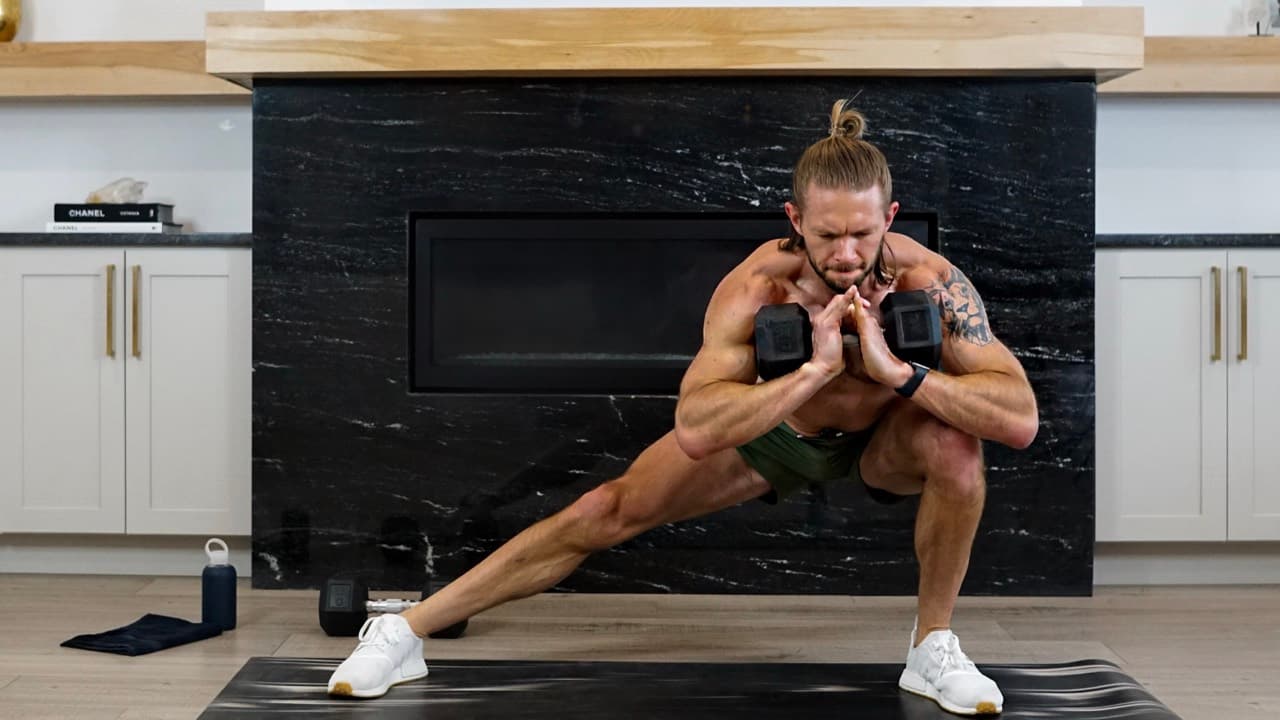
Lower body HIIT: 8 tips and a 30 minute workout
Workouts by Tiff and Dan · Updated October 7, 2026
Lower body HIIT is short, hard intervals of squats, lunges and other leg moves, with short rests in between. It's good for leg endurance, for your fitness, and for keeping your form when your legs are tired. It won't replace strength training for building muscle, so most people do best with one or two sessions a week alongside it. Below: our 30 minute lower body HIIT workout, eight tips to get more out of it, and what the 30-20-10 method really is.
- Here for the 30-20-10 method? Jump straight to it.
- Can't jump, or have sore knees? See lower body HIIT without jumping.
The 30 minute lower body HIIT workout
From week 2 of our 6 Week Shred II program: three rounds for your legs with two ab rounds in between, then a pulse finisher. Each round is four moves, done twice through. The ab rounds give your legs a short break before the next leg round.
- Time: 30 minutes of rounds, then a 2 minute finisher (the video runs 37 minutes)
- Work and rest: 30 seconds on, 15 seconds off; the finisher is 30 seconds each with no rest
- Level: intermediate to advanced
- You need: a mat
| Round | Moves, twice through |
|---|---|
| 1. Legs | Alternating reverse lunges, jump squats, alternating front lunges, frog extensions |
| 2. Abs | Cross mountain climbers, Russian twists, plank spider crunches, cross star crunches |
| 3. Legs | High knees, alternating curtsy lunges, air squats, Cossack squats |
| 4. Abs | Flutter kicks, alternating sprinter's sit ups, scissor crossovers, reverse crunch with extension and abduction |
| 5. Legs | In and out squats, high knee side shuffle, side to side squat hops, spot sprint |
| Finisher | Squat pulse, static lunge pulse (right, then left), sumo squat pulse: once through, no rest |
Make it easier: if the jumps feel rough, step them out and keep the tempo up. The no-jump swaps are below.
8 tips for better lower body HIIT
1. Know what it can and can't do
| Lower body HIIT is good for | It won't do this on its own |
|---|---|
| Leg endurance: keeping going when your legs are tired | Build much muscle size: heavier strength training does that |
| Your fitness, heart and lungs included | Replace squats, deadlifts and hip thrusts with weights |
| Control and balance on one leg when you're tired | Burn fat from your legs or hips in particular |
2. Learn the moves slowly first
HIIT doesn't fix how you move, it shows it up. Before you add speed, make sure you can do the three basic patterns slowly and with control:
- Squat: sit back, heels down, knees pointing the same way as your toes.
- Lunge: long enough step that your front knee stays over your foot, not caving in.
- Hinge or bridge: push through your heels and squeeze your glutes, without arching your lower back.
If a move falls apart at a slow pace, it will be worse at a fast one.
3. Warm up your hips and glutes
Five minutes is enough. Our 5 minute full body warm up raises your heart rate and loosens your hips. Then add a few slow glute bridges and single leg bridges, so you feel your glutes working before you start. If you have a mini band, a few side steps with it work too.
4. Pick moves that use big muscles
Squats, lunges, hinges and step ups work the most muscle at once, so they raise your heart rate and train your legs together. Add side-to-side moves like curtsy lunges, Cossack squats and side lunges for the sides of your hips. Then a few fast moves, like high knees, skaters or jump squats, to push your heart rate up. The workout above has all three.
5. Match work and rest to your level
| Level | Work | Rest | Intervals |
|---|---|---|---|
| New to HIIT | 20 seconds | 40 seconds | 8 to 10 |
| Intermediate | 30 seconds | 30 seconds | 12 to 16 |
| Advanced | 40 seconds | 20 seconds | 12 to 16 |
Our workout above is 30 seconds on and 15 off, so it sits between intermediate and advanced. If that's too much for now, pause the video for an extra 15 seconds between moves.
6. Try the 30-20-10 method
People search for a "30-20-10 glute method", but there's no single standard method by that name. It usually means one of two things:
- Timing, the original idea: every minute is 30 seconds easy, 20 seconds moderate and 10 seconds close to all out. This comes from the 10-20-30 training concept, tested at the University of Copenhagen in a 2012 study with 18 moderately trained runners. They ran blocks of five of these minutes in a row, three or four blocks with 2 minutes' rest between, instead of their usual training for 7 weeks. They got faster over 1,500 m and 5 km while running about half as much. It was tested on running, not on squats or glutes.
- Reps: 30 reps, then 20, then 10, going heavier each set. That's a strength training rep scheme, and it works best with dumbbells.
Our workout above uses neither: it's 30 seconds on, 15 off. To try the timing version with your legs:
| Seconds | Effort | Example |
|---|---|---|
| 30 | Easy | Slow bodyweight squats |
| 20 | Moderate | Faster squats |
| 10 | Close to all out | Jump squats, or the fastest squats you can do with no jump |
Do five of those minutes in a row, rest 2 minutes, and repeat. Start with two blocks. For the second one, try lunges: slow reverse lunges, faster reverse lunges, then switch lunges or fast step-back lunges.
7. Change one thing a week
Doing the same workout the same way gets easier over time. Change one thing at a time: a few more seconds of work, a few fewer seconds of rest, one more round, a light dumbbell for squats and lunges, or a harder version of a move.
| Week | Work and rest | Rounds | Change |
|---|---|---|---|
| 1 | 20 / 40 | 2 | Bodyweight only |
| 2 | 30 / 30 | 2 | A light dumbbell for squats |
| 3 | 30 / 30 | 3 | Add skaters or fast step ups |
| 4 | 40 / 20 | 3 | A slightly heavier dumbbell |
If you build your own sessions, a month could look like the table above. Keep track of how many good reps you get in each interval. That's the easiest way to see you're improving.
8. Do it once or twice a week
More lower body HIIT isn't better: too much gets in the way of recovering from your strength days. A week might look like this:
| Day | Session |
|---|---|
| Monday | Full body strength |
| Tuesday | Walk or rest |
| Wednesday | Upper body strength |
| Thursday | Lower body HIIT |
| Friday | Rest or stretching |
| Saturday | Lower body strength, heavier and slower |
| Sunday | Rest or an easy walk |
After a session your legs should feel worked, not wrecked for half the week. If they are, cut a round or add rest next time.
Lower body HIIT without jumping
You can keep the intensity up without leaving the floor: move faster, go deeper, and rest less. In the workout above, swap the jumping moves like this:
| Instead of | Do this |
|---|---|
| Jump squats | Fast bodyweight squats, rising onto your toes at the top |
| High knees and spot sprint | A fast march, knees high, arms pumping |
| In and out squats | Step out and in, squatting each time |
| Side to side squat hops | Side steps, staying low in a squat |
| High knee side shuffle | Quick side steps with no hop |
For whole workouts with no jumping, see our low impact workouts. Stop any move that gives you sharp pain in a knee or hip. And stop and get medical advice if you feel chest pain, feel faint or dizzy, or get short of breath in a way that doesn't settle when you rest.
Questions
What is the 30-20-10 glute method?
There's no single standard method. Most often it means intervals of 30 seconds easy, 20 seconds moderate and 10 seconds close to all out, an idea from a 2012 study on runners (the 10-20-30 training concept). Sometimes it means sets of 30, 20 and 10 reps, going heavier each set. Here's how to use it for your legs.
Does lower body HIIT build glutes?
It works your glutes, and if you're new to training they'll likely get stronger. To build more muscle, you need strength training that gets heavier over time, like squats, hip thrusts and Romanian deadlifts with weights. Use HIIT alongside that, not instead of it. Our glute workouts and leg workouts with dumbbells are a good place to start.
How often should I do lower body HIIT?
Once or twice a week, with a day or two between hard leg sessions. Strength training, walking and rest days fill the rest of the week.
Is lower body HIIT OK with bad knees?
Often, with changes. Step out the jumps, squat and lunge only as deep as feels fine, and skip any move that hurts. If knee pain sticks around, see a doctor or physical therapist.
Can I add dumbbells?
Yes. A light dumbbell for squats, lunges and step ups makes them harder. Keep the jumping moves to bodyweight. For workouts built around them, see dumbbell HIIT workouts.
Does lower body HIIT burn fat from your legs?
No workout burns fat from one area. HIIT uses a lot of energy for the time it takes, but losing fat comes down mostly to what you eat and how active you are overall, and where you lose it first isn't up to you.